
Metallurgy for the Non-engineer
BY RUSSELL SHERMAN, PE
Atomic Structure
8. What does it mean when a broken part looks crystallized?
When the fracture face has a rocky appearance it is because the material had a very large grain structure. Basically the grain grew during manufacturing due to poor technique and handling. A properly processed part will have a silky smooth appearance which is an indication of fine grain size. So crystallization does not occur as a result of load or fatigue – it was present in the material at the time of manufacture.
9. Define "precipitation hardening" and "phase change."
The precipitation hardening comes from microscopic precipitation of hard phases which serve to keep rows of atoms from moving under stress. Some metals undergo a change in atomic structure at high temperature. Alloy steels, which are bcc at room temperature, become fcc at temperatures above 1400°F. This switch over is called a phase change. When cooled down they revert back to the bcc structure. Management of this phase is extremely critical and ARP maintains a complete in-house heat-treatment facility. It's the only way we can assure material integrity.
10. What does a "face centered cubic" (fcc) atom arrangement look like? How many atoms?
A face centered cubic arrangement of atoms (austenitic) looks like a Las Vegas die with a five showing on all six faces. This can't be seen visually by any type of microscope.
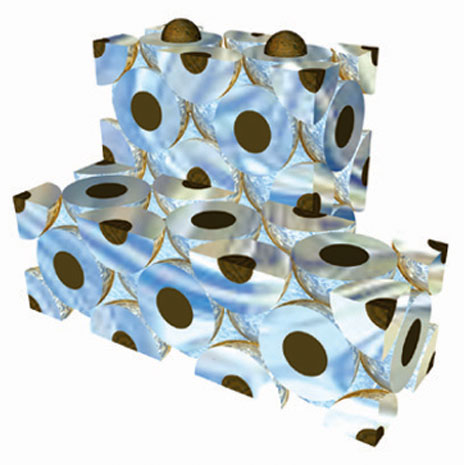
The number of atoms in any one cubic cell would be 14 – these do not stand alone but are attached to other cells which share some of the atoms.
11. How does a "body center cubic" (bcc) atom look? How many atoms?
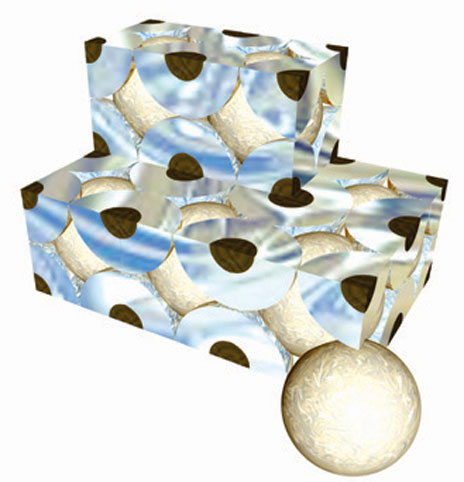
The body center cubic structure would look like a die with a four on all faces and one atom in the center of the cube. The atomic arrangement of pure iron is bcc at room temperature and does not change until the temperature reaches 1674°F. At this temperature it changes to austenite which is face center cubic (fcc). The addition of carbon to the iron lowers this transition temperature. This is the basis for heat treatment of steel. If the iron carbon alloy (steel) is quenched from the fcc field, the structure becomes martensite, a very hard strong condition.
12. What does a "stainless steel" atom arrangement look like? How many atoms?
A face centered cubic arrangement of atoms Stainless Steel 300 series is not heat-treatable. But heavy reduction (power dumping), in the cross section, during forging causes a dramatic increase in strength. This is the process ARP uses to make 304 Stainless Steel reach 170,000 psi UTS.
13. How do the space lattice or crystal structures appear?
All grains or crystals are composed of atoms bound together in a definite pattern. These structures are called space lattice or crystal structures. At a fixed temperature, the atoms in an array are spaced a definite distance from one another, although they vibrate about their mean position. Even though atoms are actually not held together in this manner, it is helpful to picture the crystals as a 3-dimensional latticework connected by imaginary lines. Metallurgists who primarily study ferrous metal are interested in only two basic crystal structures: bcc (body-centered cubic) and fcc (face-centered cubic).